

The Case for Dimes Square
My new essay in The Republic of Letters

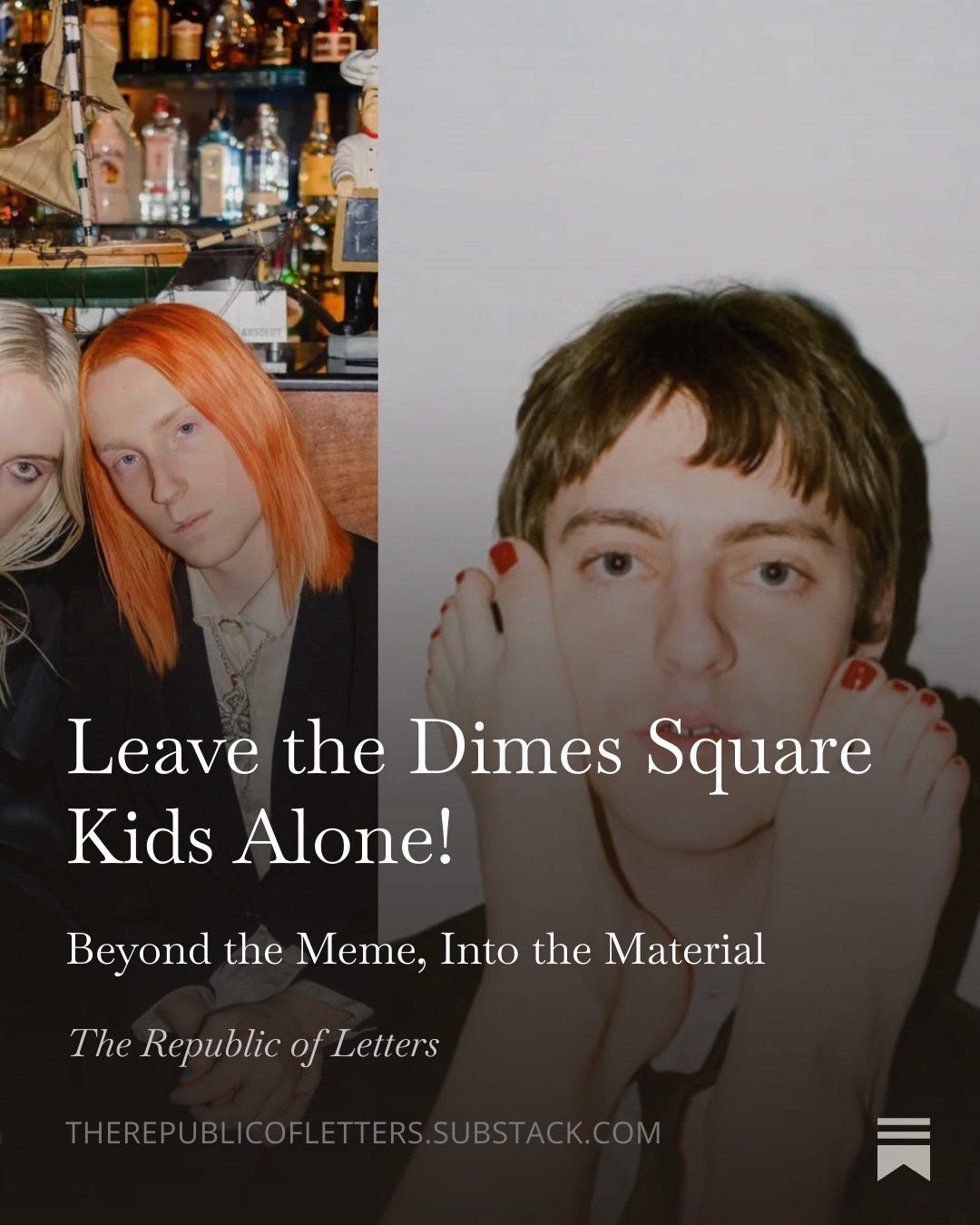
Another piece of mine ran earlier this week—this time in The Republic of Letters, who asked me to make the case for the Dimes Square literary scene as part of their Debates series.
Last year, I picked up (and also put down) a number of Dimes Square–adjacent books. Occasionally, I found something good. This is the case with any healthy scene (as is a proliferation of aspirants and posers)—whether we’re talking music, literature, or another art form. And in a time when many people seem more interested in producing “content” than novels, it makes me happy to see people trying to write fiction at all. The venomous take-downs of Dimes Square are fun and all, but I think you’ll enjoy this assessment.
Here’s the opening:
antiart’s viral declaration last year that Dimes Square is dead and nothing good came out of it is almost convincing. After all, it’s hard to see that any good art has come out of anywhere in the content surfeit of the last decade. But while his essay skewers the scene’s film and music output, it overlooks the writing. Before we drag the corpse of Dimes Square through the streets of Milan and mutilate it beyond recognition (the fate not just of fascist dictators and their mistresses, but of any scene when it gets distorted into myth), it’s worth asking what its writers have left behind and whether it has truly run its course.
The first problem with the discourse around Dimes Square is that it means different things to different people. Any meaningful discussion about the scene requires a kind of triangulation of its physical actuality (the neighborhood itself, the people, the output), its mediated representation (the media coverage, the discourse around it), and, finally, Dimes Square the meme. As it is the natural unit of expression in a digital world, the meme may be the version that carries the most cultural weight, but underneath its recursive layers, there’s something more substantial: a small but significant body of literature, which might be among the least discussed aspects of Dimes Square.
The downtown scene takes its name from a Chinatown restaurant that once stood at the neighborhood’s epicenter, “an unremarkable concrete triangle speckled with a few good bars.” In the years leading up to COVID, Dimes Square gained cultural cachet, drawing the young, the rich, the beautiful, and the art-minded. During the pandemic, it took on a controversial overtone as it became a gathering spot for maskless twenty-somethings flaunting their well-functioning immune systems and their youthful indifference to death. Whether they meant to or not, they were also making a political statement at a time when mask-wearing itself had become politicized. Whatever the intentions, a new zeitgeist seemed to be forming—or at least a narrative about one.
Read the rest at The Republic of Letters.
Like what you’ve read? Share it with your friends!
Want to help support my work?
XO,
Jesse