

The Art-Content Matrix
A diagram for aesthetics in the digital age

After wrapping up some other writing projects, I’m excited to return to my essay collection, which I initially talked about here. So far I’ve discussed How Social Media Is Killing the Essay (part 1 and part 2), and while I have more to say on that, it felt like it was time to move into the realm of aesthetic theory.
The Art-Content Matrix: A Diagram for Aesthetics in the Digital Age
Lately, my most common reaction to most new television, film, and online media is, well, to ignore it, just like I coldly ignore the content filling up my inboxes and the margins of websites and apps. Most of the time, it doesn’t even register. Congratulations, 20th-century post-Empire America, the fruits of your artistic efforts amount to the same as junk mail.
While there seems to be creativity everywhere, much of this output is no longer art but filler used to monetize space (obscenely infinite in the digital world), sustain brands, and carefully mold and polarize opinion. Hence, the ascendancy of the dreaded word in our age: ”content.”
The fact that our most discerning intellectuals are producing think pieces on aggressively mediocre pop stars—where much of that actual talent comes from music producers—and films as if they were cultural events is a symptom not just of the engines of late capitalism but of “culture” metastasizing so indiscriminately that it no longer distinguishes between art and content.
And yet, while this distinction has “never been more important,” it seems to be one that fewer and fewer consumers of culture would seem able, or willing, to make.
So how can you tell the difference between the two, and when do they overlap? What follows is a four-quadrant matrix to help distinguish the various orientations that inform an aesthetic work. It isn’t intended to function as a scientific taxonomy but to expand the vocabulary for discussing art. Some of the most interesting artists and works of art can migrate between or straddle multiple quadrants.
The point of all this isn’t to tell you what to like. The point is to make visible some of the differences between art and content so both audiences and artists can better judge the quality of a work and whether or not it deserves their attention.
The Art-Content Matrix
What is it about art that makes it different from content? And what is it about content that makes it content and not art?
Creatives (defined here as those who make aesthetic content) can be but are not necessarily artists. And artists may not always make art; when certain motivations and considerations enter the picture of their creation, it’s easy to slide into the category of content.1
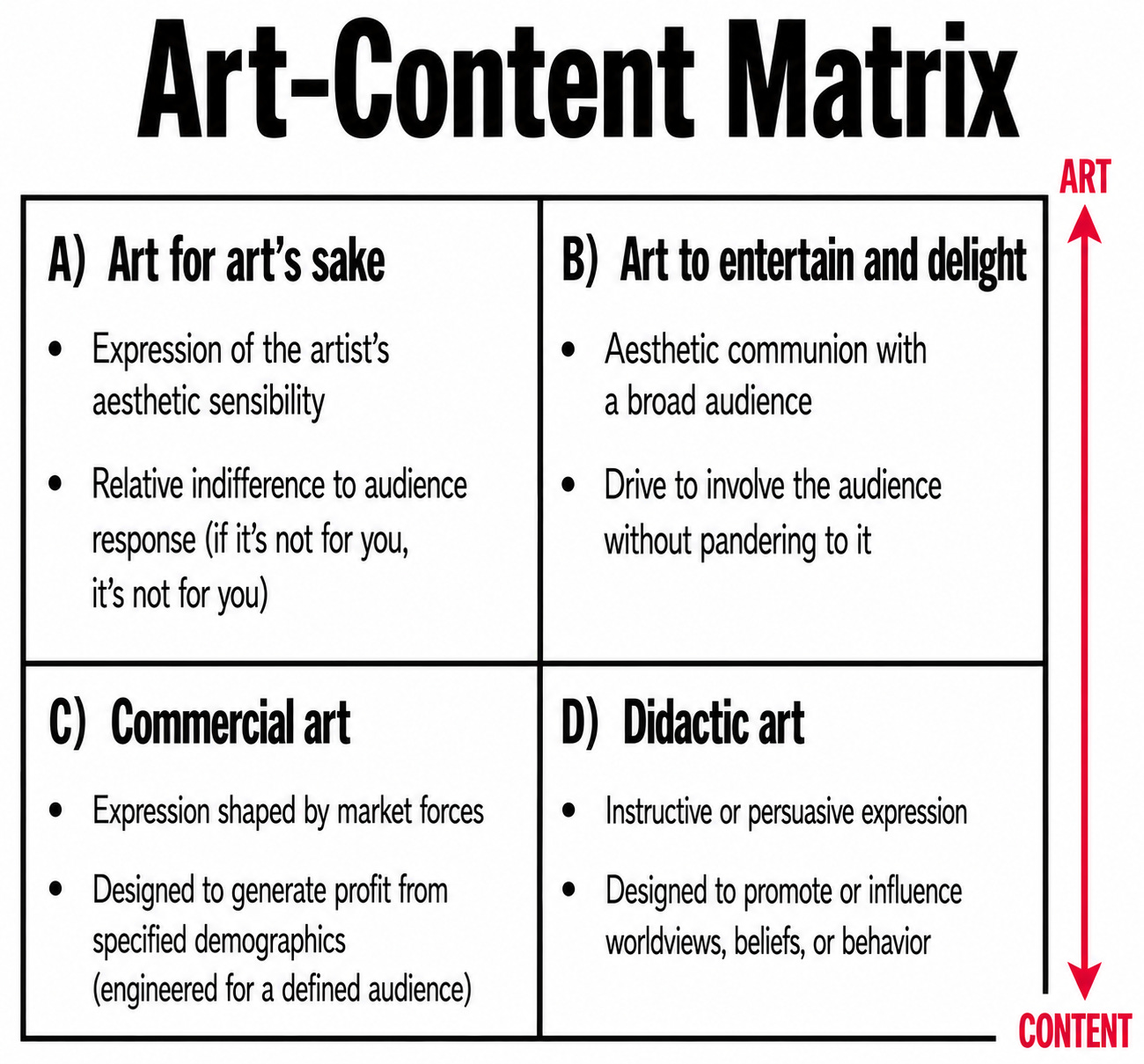
Art is fundamentally a communication delivered through aesthetics. An aesthetic work, no matter the medium, can fall within one of four quadrants, depending on its purpose. The top two belong to the province of art, and the other two fall between art and content.
Art for art’s sake
Art for entertainment
Commercial art
Didactic art
This is a framework for understanding aesthetic works—not works that are designed purely with the purpose to inform or sell, for example, such as the news or advertising. As we’ll see, such things show up in our matrix only when they’re packaged into aesthetic content.
Taking a step back, we can see that the lower quadrants are really where aesthetics and content intersect. In the right circle below, you’ll find an infinite expanse of content (which can include product descriptions, blog articles, newsletters, etc.). For our purposes, we’re not interested in this side, and so I’ve lobbed it off.
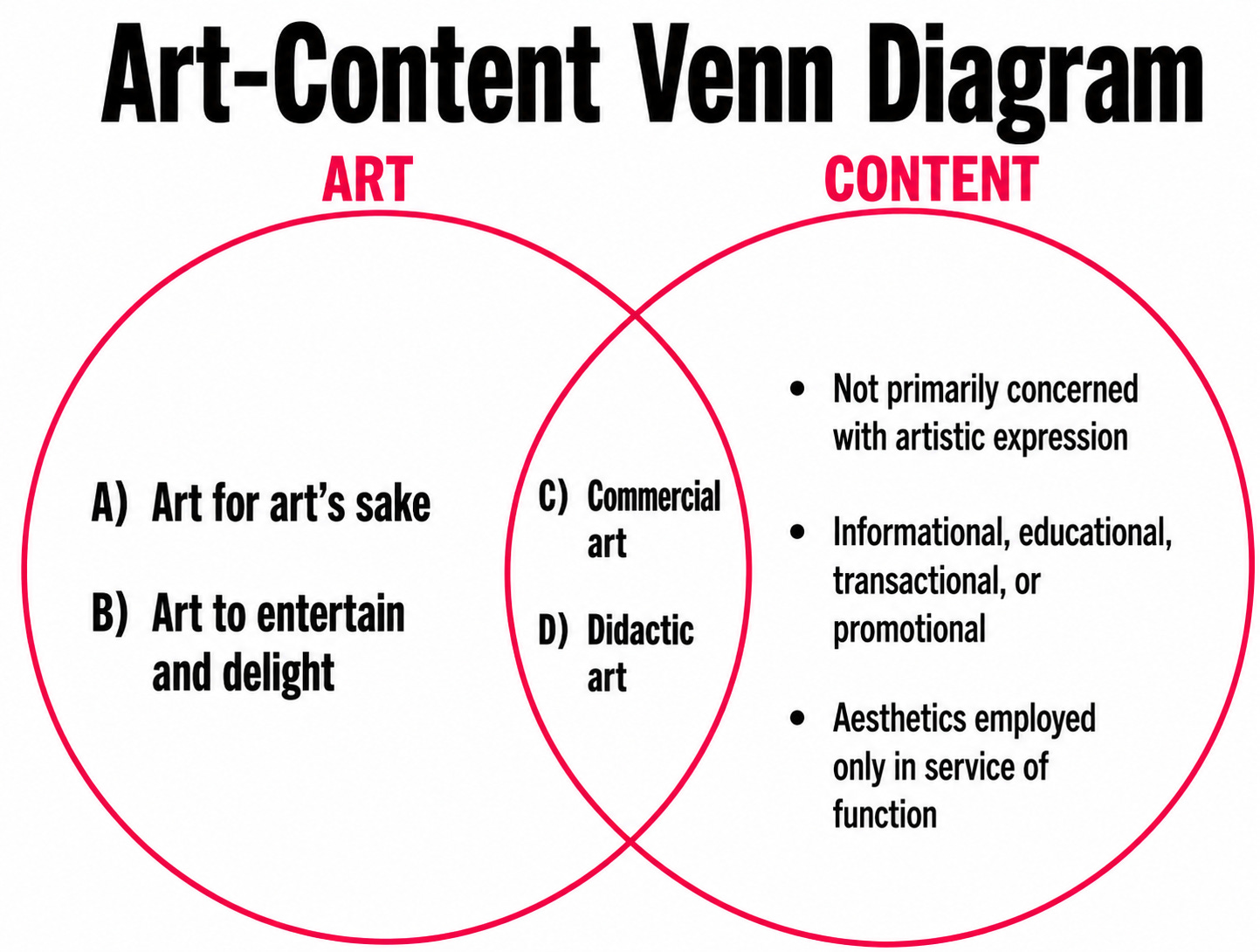
All content employs aesthetics to some degree (e.g., prose rhythm, typography, visual composition), just as all art contains aspects of content (e.g., audience consideration, readability, information hierarchy). The distinction lies in what the work is ultimately in service of—its purpose.
Returning to the matrix, creative motivations generally fall into two types: projects driven by expression, and projects driven toward external ends, such as commercial profit (e.g., selling the work directly, attracting advertisers, building confidence in a brand), persuasion (selling ideas), and influence or prestige (selling oneself). This is the fundamental line of demarcation: The “purer” artistic works, primarily motivated by the former, are situated at the top of the matrix, and the latter—as we see with most streaming TV and “Oscar bait” movies these days—on the bottom.
It’s not that external motivations aren’t present in “pure” art. This is just as true as there can be qualities from the top quadrants in the bottom ones. As we’ll see in later examples, there are layers to a work, and some subjectivity in their interpretation. The important thing to remember is that this matrix is a tool that can be used to illuminate different artistic orientations.
Main Factors
There are three main factors that play into where a piece of work lands on the matrix. These are: the degree of consideration for the audience, the motivation (essentially, expressing vs. selling), and where the art comes from (the “river of aesthetics” vs. purely analytical thinking).
1. Audience: How much does the audience influence the work?
2. Purpose: Is the intention to express oneself artistically, or is it to sell or promote?
3. Source: Is the work analytically engineered, or does it emerge from the “river of aesthetics”?
Breaking Down the Art-Content Matrix
Art (Upper Quadrants)
As a rule, the more specifically you define your audience as part of the creative process, the less it will function as art and the more it will function as content. Conversely, the more an audience expects work that fits their demographics, the more they are looking for content and not art.
As objective as I’d like to think quality is (any critic or teacher would have to believe this to some degree in order to judge the merits of a work), this matrix doesn’t explicitly deal with quality as a criterion. It doesn’t care how good or bad an artistic work is. This opens the door to artists of all ages and abilities to participate in the upper quadrants.
However, an artist’s regard for quality compared to other characteristics of the work, such as commercial viability, would be a factor. The matrix is teleological in nature—meaning having to do with purpose: The difference between art and content, and between each of these quadrants, is the end the work is aimed at. Whereas an artist is motivated by artistic expression (the use of aesthetics to articulate something in an act of discovery), content uses aesthetics to reliably produce a desired effect.
In the case of the upper quadrants of art, the rigorous pursuit of “perfection” (which in itself is an aesthetic pursuit), quality is more subjective according to the personal aesthetics of the artist. And in the lower quadrants, aesthetic quality tends to be only important to the degree that it can achieve the desired effect (attract viewers, change people’s minds, etc.).
Finally, as mentioned above, we have the River of Aesthetics, the most scientific and concrete part of this essay. (You can find an extended description in this review. For now, I will summarize it.) As touched upon above under the factor of the source of a work, an aesthetic work can be discovered or contrived. This contrived quality is the problem I have with much contemporary fiction: instead of drawing from the River of Aesthetics, the author relies on a lesser form of imagination. As a professional copywriter, I’m well acquainted with this baser imagination, as it is particularly useful in selling things. One employs it calculatingly, using analytic faculties and guided by creative briefs (which summarize, among other things, objectives, audience demographics, and brand positioning) to produce something that might feel spontaneous but is, in fact, engineered. It may be artful, but it is not art. Art-making, by contrast, is a more mystic process. The collective aesthetic consciousness may perhaps manifest itself in various user interfaces—I’ve heard it elsewhere described as a cave—but at least one other artist I’ve traded notes with agrees that a river aptly describes the interminable channel of images that rushes past when this imagination is activated. There’s a spirit of discovery and spontaneity when fishing out of the River of Aesthetics. You never know what sparkling, trembling specimen you’ll scoop out, but you can be sure that it flops with life of its own. So even though what you draw from the River may be totally made up, it is never contrived, and often proves more convincing than reality itself.
A. Art for art’s sake
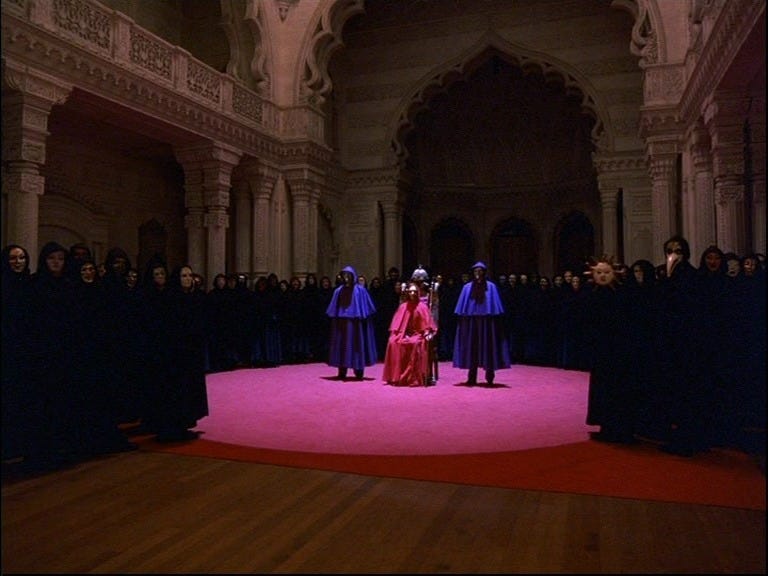
With art for art’s sake, the artist is motivated by a drive to bring an artistic vision to life without regard for whether it will appeal to a broad audience. While an artist working within this quadrant (and artists can go all over the quadrants throughout their career or even at the same time—gotta pay those bills) may appreciate the approbation and accolades of their peers or audience, or be devastated by their rejection, public reception of the work is beside the point: They have a vision they’re going to realize, whether or not their comrades approve. First-quadrant artists may work for years or their entire careers thanklessly pursuing their artistic vision, happily or unhappily.
Quadrant A is not equivalent to originality, sincerity, authenticity, moral virtue, or talent. The distinction is that the Quadrant A artist is creating for himself, and perhaps also for posterity—a bestowment to humanity in the abstract; his work is a personal vision pursued primarily for its own realization—or one shared by multiple artists in a collective work, such as with film or music. This is the province of original, groundbreaking art (Ulysses, The Sun Also Rises), as well as auteur works that aren’t necessarily groundbreaking but expressions of the artist’s sensibility (Women by Charles Bukowski, Jesus’ Son by Denis Johnson), and in the case especially of younger or less developed artists, even derivative works. Their work could suck or be great. It could be beautiful or have a perverse idea of beauty, depending on the artist’s particular aesthetic. And the artist could be pretentious, self-mythologizing, an outright fraud, or otherwise insufferable in any number of ways.
Andy Warhol comes to mind as the perfect example of an artist that could be considered one such phony. Indeed, many might reasonably argue that he’s more suitably placed in Quadrant C, but at the very least, he’s more of a Quadrant AC artist. The commercial appeal of Warhol’s works was deliberately ironic or ambiguous. As an artist, his work explored the boundaries between art and commerce (while also further breaking them down), and he played with elements like mass production, advertising, consumer culture, and celebrity. At the same time, his work took on a life of its own, and Warhol himself became a brand and cash cow in his own right, illustrating the irony of irony: the longer you pretend to be something, no matter how self-aware you are at the time, the more likely you are eventually to become it. Thus some find him to be an obnoxious Quadrant C artist and others look up to him as a Quadrant C artist (making aesthetic works primarily for money is not inherently terrible, and neither is the work—much formulaic television content brought me comfort in my formative years; some even straddled the upper quadrants in fascinating ways). But I would place him in both Quadrants A and C.
The reason Warhol belongs at least partly in Quadrant A is that he didn’t start out giving audiences what they wanted. Only after imposing his singular sensibility on the culture did that sensibility become a marketable brand and shape public taste. At that point, he appears to hop over into Quadrant C as he manufactured his art in accordance with a branded template for commercial gain or brand-building. Some could argue that he stayed put in Quadrant A, and as a sort of performance artist, enacted a show in Quadrant C for his artistic benefit. Indeed, I think many artists in today’s brand-conscious and money-centric art world might look something like Warhol, a reversible image that can be perceived two different ways: soulless Quadrant C dwellers or Quadrant A artists staging a performance for its own sake.
It’s not that the Quadrant A artist is completely cold to the response of others. In most cases, they care at least to some degree about the reception because what is the point of making art, after all, if there’s absolutely no one to share it with? But the perceived reception doesn’t influence the making, except insofar as the artist seeks to provoke, dismay, or otherwise challenge the status quo. The Quadrant A artist imagines their contribution as one made to art itself, or to future audiences who will one day appreciate their aesthetic vision, rather than to the tastes of today’s audience.
Whereas Quadrant B-er Steven Spielberg “targets” mass audiences—humanity as a whole, it seems—Quentin Tarantino makes work from his own sensibility; while he seeks to give pleasure, it is first and foremost for the benefit of himself, and after that, to those who share his taste.
It may seem at times, especially if you’re a fan, that Tarantino likes to give the audience what it wants, but let’s not forget his uniquely extravagant (and often hilarious) depictions of violence, extended monologues, long digressions, tonal volatility, cinephiliac eccentricities, and other such indulgences that likely alienate just as much as they delight.2 While Tarantino has managed to straddle quadrants A and B, he has done so by compelling audiences to embrace his unique tastes rather than attempting to cater to theirs—the mark of a truly influential artist.
B. Art to entertain and delight
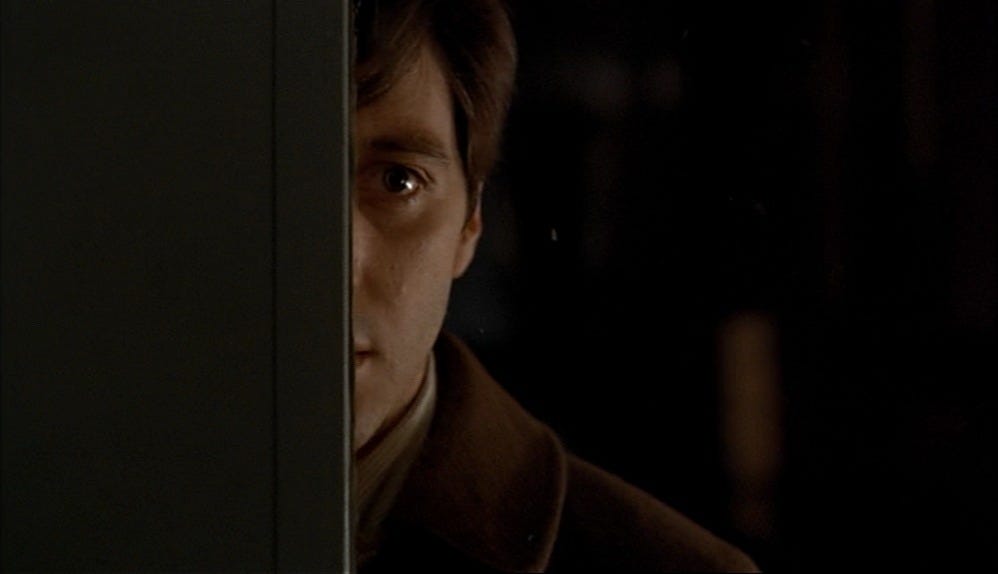
In Quadrant B, we have art for the sake of entertainment: the artist remains faithful to his personal vision while desiring his work to be understood and enjoyed by others. This is where the artist becomes inclusive of the audience and invites them into his world.
Remaining faithful to a personal vision while still reaching a wide audience—this is the guiding belief of Quadrant B, and of artists who dream big. The Quadrant A artist often produces their work for an audience as well as themself; Quadrant B’s focus is on the response of the audience—not their engagement after the fact on social media, but their emotional experience as they watch or read or listen.
Coppola most assuredly had a personal vision with The Godfather, but he wanted audiences to be affected by the story. It’s elevated, but it’s not indifferent to the audience’s comprehension or pleasure; he crafted it to be emotionally compelling to a mass audience, rather than to an audience inclined toward his unique sensibility (as with Tarantino).
Art for the sake of entertainment isn’t necessarily any less artistic or pure than art for art’s sake. It extends from the highbrow to lowbrow; art for art’s sake has a tendency to be more highbrow (technically defined by its distance from mass appeal), while art aimed at entertaining broader audiences tends to move toward the lower brow. But the two are not mutually exclusive. Many of the greatest examples involve both—e.g., Shakespeare’s plays, which were written to appeal to the mass audiences of the Globe Theatre with bawdy jokes, swordplay, and rustic clown slapstick.
Quadrant A vs. B is NOT: obscure vs. popular, difficult vs. accessible, or highbrow vs. lowbrow.
Quadrant A vs. B IS: internal obligation vs. outward intent; a contribution to the tradition of art vs. an invitation to collective experience; vision-first regardless of reception vs. vision shaped with reception in mind.
In Quadrant B, the artist wants the work to give pleasure or move the audience. But it’s not all sweetness and light; it can be cynical, and boldly so. The point is that rather than throwing cynicism in the audience’s face, it appeals to their darker instincts and moral intelligence (L.A. Confidential, Goodfellas). The artist is brooding with us, not at us.
A lot of comedy falls into this category, as its success is so directly tied to audience response (for a joke to “work,” it has to make the audience laugh). This is the case even for comedy that might be considered “tasteless.” (Taste, as with quality, isn’t integral to Art-Content Matrix.) Monty Python, South Park, Rick and Morty, et al. can all be considered art. At times they may fit into category A, where comedy is so insular that it’s designed to bring amusement to just the artist or his inner circle of friends, such as with the work of Andy Kaufman. At other times they may fit into Category C, which I have yet to get to, but which is the province of corporate art—content for commercial ends—putting out an episode to fulfill a contractual obligation with the network, for example.
Thinking about “what audiences want,” not what audiences will pay for, is what separates this category from corporate art. I don’t mean what audiences think they want, or what the marketing division tells executives audiences want. I mean what they want on a visceral, unconscious level—what they “didn’t know they needed.”
The consideration of what the audience (thinks it) wants, and the importance placed on it, is the hinge on which this entire matrix turns. This is the determining factor that pushes a work entirely out of the province of art and into content. Quadrant B cares about winning over the audience’s hearts and minds, but without pandering. The artist can’t care to the degree that they mar the work and reduce its quality.
In Quadrant B, there is the belief that an artist can create a popular work that is satisfying to both the artist and audience; but aesthetic fulfillment for its own sake is the goal, not commercial success. We might call this fulfillment τέλος (telos), Aristotle’s term for the end or purpose toward which a thing is directed.
The default mode of mid-century popular music was art meant to delight audiences. While studios were no doubt trying to manufacture hits, the music was still driven by artistic vision—as with Motown, whose assembly-line hits didn’t come at the expense of the music itself. As throughout most of history, the music was social by its very nature; it was played to be heard, shared with others, danced to, sung along with, etc. In The Beach Boys’ Pet Sounds, Brian Wilson followed a deeply personal musical vision, comprising complex harmonies and unusual instrumentation, but the goal wasn’t private experimentation but to communicate with others. As such, the record lands in Quadrant B as unabashedly pop, demonstrating how ambitious, sincere art could exist within a popular form.
During this period, the structure of the music industry made Quadrant B the dominant mode. Recording was relegated to studios due to the expense; distribution was controlled by labels; and radio airplay was the blessing from God or kiss of death needed to make or break a career. Within this system, artists needed a large audience. So they generally aimed to delight listeners rather than retreat into purely personal expression.
Quadrant A music became more common later, when niche audiences and independent scenes allowed artists to create work that didn’t require mass approval for its existence. Folk revival artists started pushing more toward personal songwriting; experimental and avant-garde composers outside of pop culture were rising. Toward the end of the 60s, pop began to move toward personal artistic exploration in the early experimental rock scene, where the reigning sentiment of the artist was, “If you don’t get it, it’s not for you.” Once the monoculture fragmented and niche audiences became more viable in the 1970s with scenes emerging across subcultures (heavy metal, punk, post-punk, and indie-rock, etc.), Quadrant A found increasing expression, later to be followed by hyperpersonal niches. One could consider a nascent scene or subculture to be an extension of the artist rather than the great audiences of Quadrant B. But it could also be argued that as niche audiences grew, they began to take on the character of a general audience to which artists could be inclusive (Quadrant B) or sell out (Quadrant C).
Quadrant B is where much of the greatest art has historically lived. It represents a tenuous equilibrium between artistic vision and audience connection. The artist is not indifferent to the audience, but neither is the work engineered to satisfy them. This quadrant once formed the beating heart of popular culture in the Empire. We can argue that the tragedy of the digital age is that Quadrant B is disappearing; the best examples belong to previous eras. The rise of the digital age has since seen the displacement of Quadrant B from the cultural center and the fragmentation of artistic creation into the other quadrants—heavily niche art (e.g., the various alt lit presses which each seem to have a brand and audience of their own) and the content of the lower quadrants, which seem to have overtaken the film industry and streaming television.3
And so now that we’ve had our fill of twentieth-century nostalgia, let us descend into the lower depths of human creation into Quadrants C and D …
Content (Lower Quadrants)
Lying behind the motive of self-expression may be the desire to make something beautiful, to move oneself (Quadrant A) or to move others (Quadrant B), to exorcise one’s demons, to heal one’s pain, etc. It may even be the desire to express one’s individual ideas, including the moral rot of one’s time, in hopes that others will recognize the situation and change (e.g., Émile Zola’s novel cycle, Les Rougon-Macquart). But when the work becomes primarily an “engine” (the very word gives it away) for profit, gain, or the spreading of ideas, we find ourselves in the Land of Content.
As audience measurement has come to define marketing—from the rise of Nielsen ratings in the latter half of the last century to today’s hyper-specific streaming data—so has the production of content tailored to defined demographics. Audiences, in turn, have become accustomed to content specifically developed for them and their tastes, based on their demographics as a user “identity” (the word is a misnomer, as really these “identities” are group descriptors). The audiences of would-be artists have been replaced by a seemingly endless proliferation of “target” audiences.
C. Commercial art
In Quadrant C, we’ve moved from artistic expression to content production. The Quadrant B artist is motivated to express themself through the use of aesthetics to articulate something whose value isn’t known in advance, with the ultimate goal of affecting their audience. Quadrant C is all about reverse-engineering a desired outcome from the audience that has been fixed beforehand, and then optimizing the content for that outcome. This is the province of the streaming service plugged into the marketing team, the music executive looking to package the next big thing, the YouTube influencer crafting content for engagement.
An example of Quadrant C at its purest is Puppyhood, a 2015 branded content series by Purina Puppy Chow presented by BuzzFeedVideo. While the series is about a guy getting a new puppy, it’s actually a content marketing vehicle for … dog food. It’s essentially a TV show–style commercial, which isn’t much different from a lot of other movies and TV shows when you really look at them (children’s cartoons, IP TV offshoots, franchise spin-offs, etc.). What’s more, commercials disguised as Quadrant B content don’t have to sell a product; the content itself can be the product, as is the case with studios and streaming channels.
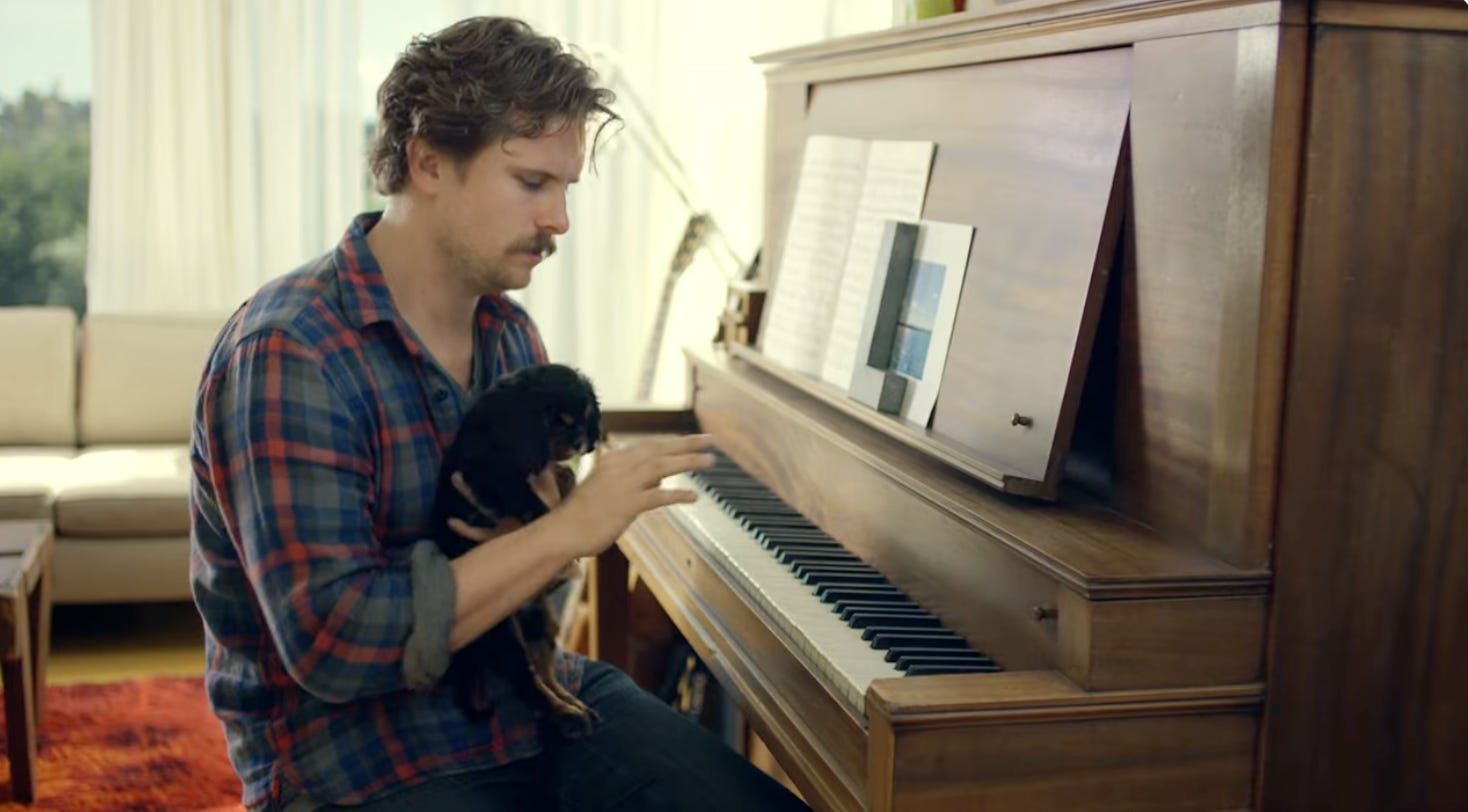
Here the orientation is fully on the audience, just as any marketing campaign would be. These are not intrinsically ignoble qualities—have I mentioned I work in marketing? The problem is when people pretend that they’re making art when they’re simply borrowing from its toolcase. Any “art” influenced by notes from executives, engagement metrics, etc.—that is, not from art’s visionaries or technicians but by its suits (not that all suits are philistines or lacking artistic instincts)—becomes marketing.
The quadrant of corporate art isn’t necessarily motivated by venality, filled with corporate types slavering over profits with neon green dollar signs for pupils. For many, in this realm where many keep 9-to-5s, the motivation may be simply to make a stable living, or to bring sufficient revenues that won’t cost them their jobs.
The Real World
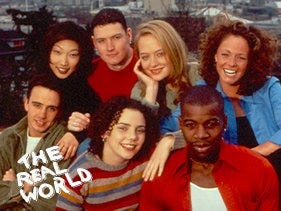
The rise of Nielsen ratings, which allowed TV networks to measure their audience, made it easier for networks to attract advertisers and increased the incentive to build entire channels around them, such as MTV for the youth segment. It also influenced the content they produced, which served as a way to deliver a predictable audience to advertisers.
It’s hard to believe it, but there was a time when MTV just played music videos. But that wasn’t enough to keep their audience engaged; the network would need to add personalities and narrative. And thus, The Real World (1992) was born. Using “real” people made the show cheap to produce, and the compelling format created repeat viewership. This is a key moment where programming was engineered to appeal to a specific demographic and generate repeat engagement.
Weezer
It’s not just studios or corporations that belong here. Under Quadrant C you’ll find the paint-by-numbers artists, the “sellouts,” and the great artists who retire from their career of artistic innovation to become touring artists, literally or figuratively, who earn their living off repeating the winning formula.4
Once an artist becomes a brand, it’s all too easy to slip from the top to bottom quadrants by adhering to brand standards rather than creating their art newly in the moment with a desire to satisfy themselves (Quadrant A) or affect others (Quadrant B). Every so often an artist can very ironically return to their own schtick, creating a newly fresh art that plays with their brand (e.g., Nicolas Cage), but more often than not, even after a Lost in Translation, you end up with A Very Murray Christmas.

Weezer’s career, which has involved rotation around the various quadrants, finally landed them, like many successful bands, in Quadrant C. This artistic journey gives us some insights into this quadrant as distinct from the others.
Their triple-platinum Blue Album is the ultimate Quadrant B work, taking the harmony, hooks, and earnestness of power pop, adding in irony, and blowing it up to an anthemic scale. It wants very much to be liked, like a letterman-clad high schooler by his sweetheart, but it wants more than that to fulfill its own vision.
This was followed by Pinkerton, which is more Quadrant A in its personal expression with confessional songwriting, depicting loneliness, sexual frustration, insecurities, etc. against a backdrop of melodic, hook-driven power-pop, but with rawer production; it doesn’t attempt to recreate a winning formula, but evolves artistically, seemingly neutral to its reception. But alas, the fans no likey: the album sold just 1.1 million copies in the U.S., compared to just over 3.5 million for The Blue Album. After this apparent public rejection, Weezer took a big break and Rivers Cuomo retreated into academia, emerging several years later with a … reconsidered approach, realized in Weezer (2001)—and the move into Quadrant C was complete.
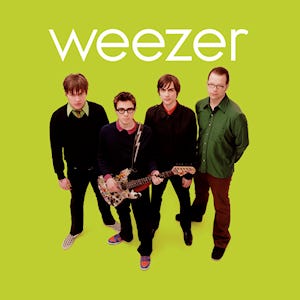
The album was more commercially oriented, more accessible and polished with shorter, simplified songs and a more uniform tone, a deliberate move away from the personal expression and risk-taking of Pinkerton. It’s not a coincidence this album earned itself the nickname The Green Album for its solid background of green—the color of filthy lucre. Of course, they were not necessarily following the money so much as what it represents—public acceptance.
I stand by the theory that the color was a deliberate choice. It’s safe to say that starting at this point in their career, Weezer’s teleological orientation is so oriented toward the audience that the albums are no longer artistic expression but musical content, a product, fulfilling the qualities of any other corporate product: predictable, repeatable, and designed for broad, if not mass, appeal.
Future albums follow in a similar light. This is where I draw absolutely blank on the band, as I simply stopped following them. But I do remember hearing “Beverly Hills” (2005) in which the song’s speaker unironically pines after a life among the stars, and I knew the band had jumped the shark.5
Notably, the band has focused its tours on its more substantially artistic albums. In the Memories Tour (2010–2012), the band, after a couple of their annoying later hits like “Beverly Hills,” “Hash Pipe,” and “Pork and Beans,”6 played both The Blue Album and Pinkerton in full. In Indie Rock Roadtrip (2023), which I missed, again they played Blue and Pinkerton in full. And finally in Voyage to the Blue Planet Tour (2024), besides some later-career hits and select Pinkerton songs, The Blue Album was not only played in full but playing it was conceived within the tour’s conceit as the only way of reviving the dying Blue Planet, which the band had traveled to on a dangerous mission through space. “One small step for Weezer, one giant leap for Weezer-kind,” Rivers Cuomo announced as he planted a flag with the band’s logo, and then the band played the entire Blue Album from start to finish.
Blurred Lines
The lines aren’t always so clear between B and C—and D. The divide between Quadrants B and C can be especially hazy for “hack” or underdeveloped “artists,” who, despite my uncharitable quotation marks, are still artists after all. Some people would like to think they’re creating art—for example, genre novels—in Quadrant B when I would place their “art” in C. You’ll also find works that aspire to Quadrant B but are compromised by an over-awareness of marketability or the artist’s personal status, resulting in their straddling both Quadrants B and C. This can happen in the case of an artist whose taste or tolerance for criticism has been formed by years of chasing social media audiences or by their day job as a corporate “creative,” or by the influence of an editor or executive giving notes to align with market research—as evinced by the profusion of mediocre streaming-era franchise movies and nostalgia remakes. And as we’ll see later, the mark of an immature artist is the type of hit-you-over-the-head moralizing or didacticism that characterizes Quadrant D. In cases like this, subjectivity rules, and the distinction ultimately comes down to the eye of the beholder in terms of their taste and talent.
Sometimes art becomes content when it outlives its original telos. One sees this with the law of diminishing returns in aesthetics: most films and TV shows decline when extended into sequels or additional seasons. Did Mike White really need to pump out three seasons of White Lotus after the Quadrant B achievement that was season one? Alas, I couldn’t even get through season two. Fleabag season two, while it failed to stick the landing as gracefully as it did in season one, is one of the rare instances of a Quadrant A sequel that “delivers,” saved no doubt by Hot Priest.
Sometimes art that belongs in Quadrant B will contain elements of Quadrant C (or Quadrant D, the ideology quadrant—we’ll get there soon) due to templated conventions. Following a formula doesn’t necessarily make them works of Quadrant C, but it weakens them. While the writing can be truly excellent at the sentence level in some contemporary novels that I’ll leave unnamed, I find that I often DNF them. One of the biggest offenders is the predictable back-and-forth timeline that’s supposed to drive the reader forward in order to discover the series of events that landed the protagonist in their current unlikely situation. Rather than piquing my interest, it registers as not only paint-by-numbers but also contrived, revealing not just the inelegant hands of the author but the commercial machinery behind it.7
D. Didactic art
Finally, we have content that serves as vessels for ideas with the primary purpose of spreading these ideas to the audience.
Such ideas also include ideology. What is meant by ideology? I prefer the Routledge Encyclopedia of Philosophy definition: “a set of ideas, beliefs, and attitudes, consciously or unconsciously held, which reflects or shapes understandings or misconceptions of the social and political world.” Ideology turns ideas into belief systems held in common by a group, which can be expressed through “identity” signals.8
This is the province of film and other media that seek to instruct, uplift, correct, or model virtue more than they want to be good art.
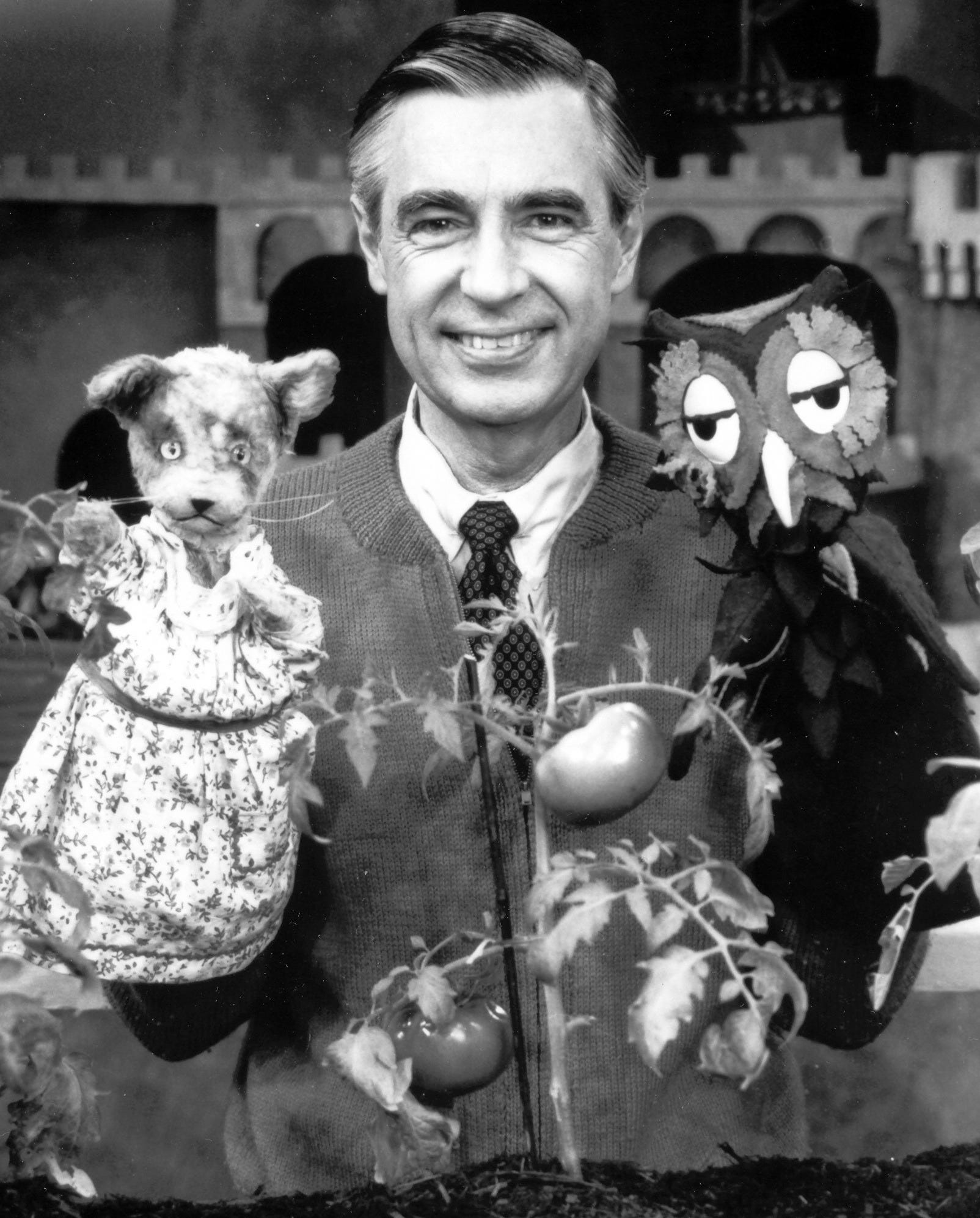
But that’s not to say that Quadrant D is inherently bad, or malign. Any functioning civilization requires educational, moral, philosophical, religious, and other didactic texts — and all the better when they’re made with aesthetics in mind. Problems arise not with the persuasion itself, but when 1) the artistic vision doesn’t rise to the level of the persuasive aim, turning the work into an act of propaganda, branding, or handholding, or 2) the message being imparted is a destructive or malign one indeed. This is where you’ll find most children’s art, even while they might contain elements of A and B. Examples of Quadrant D at its best include Mr. Rogers’ Neighborhood, Animal Farm, John Berger’s Ways of Seeing, and Do the Right Thing.
In this quadrant we have a spectrum that goes from good to evil—ideologies that spread understanding and love for one’s fellows and improve society now and into the future to ones that, despite their most convincing protestations otherwise, lead to destruction of humankind. It spans everything from Sesame Street to Nazi propaganda films. It’s not for me to spell out which ones are which for you (such differentiation seems to be one of the defining problems of post-Enlightenment life on earth, and of life on the internet, where you can participate in a highly politicized live debate about it 24/7).
There’s also another spectrum, artfulness vs. lesser artfulness, which really is a matter of quality—even while quality, as mentioned above, isn’t a primary consideration. Despite their ideology, some works lean much more artistic, placing them in Quadrant B, even while they hammer their messaging home. Parasite wasn’t my favorite movie, but I can’t argue with its artfulness; however, its class resentment theme, which in the end seems to justify the parasitic arrangement (no spoilers) became a distraction. Another example is the Bollywood smash hit (which I loved), RRR. In this historical action epic set in colonial India, two revolutionaries team up to fight British imperialism. For all of its Quadrant B-eautiful crowd-delighting set pieces, whose exuberance are so grandiose as to to tip into the absurd, the British are depicted as unequivocal villains, and the unabashed spirit of nationalism—equated with unity and rebellion—rises to such glorious emotional and aesthetic heights that the movie creeps into uncomfortable Quadrant D territory, so that one one wonders if the movie isn’t as much an expression of friendship and solidarity as it is a call to action for a new nationalism.
Conversely, badly executed art meant to delight (Quadrant B) often looks a lot like ideological content, tantamount to eating your vegetables and making the audience feel good or proud of themselves, or likely to share it with others whose opinions they would like to sway on some issue. The story progresses exactly as one would expect, each revelation confirming what the audience already “knows,” with character motivations neatly explained, black-and-white moral lines cleanly drawn, and zero risk of misinterpretation, or independent thought. In the Oscar-winning prestigebait, Spotlight, the church is corrupt, the journalists are righteous, it’s always triumphant for journalists to be able to override confidentiality laws because their motives will always be pure. It’s not that the artist wants to beat the audience over the head with a message, but such inelegance is often the mark of an artist whose understanding of nuance isn’t yet fully formed.
There are interesting artists who might at first glance appear to belong in Quadrant D because they use the medium of propaganda as part of their art, borrowing elements such as direct address to the audience and the media (public spaces, poster boards, etc.). Banksy and Barbara Kruger come to mind.

While they use the language of ideology, their telos (purpose) isn’t to sell or impose an ideology (converting people to a belief system or organizing a political or religious movement). Banksy in his weaker moments can come across as didactic, sentimentalizing, or gift-shop-merchandise clever, and Kruger hits you over the head with her Orwellian aesthetics, bringing them at times into the lower quadrants, but they remain at the core more interested in “interrogating” the methods of marketing and propaganda than in forwarding them.
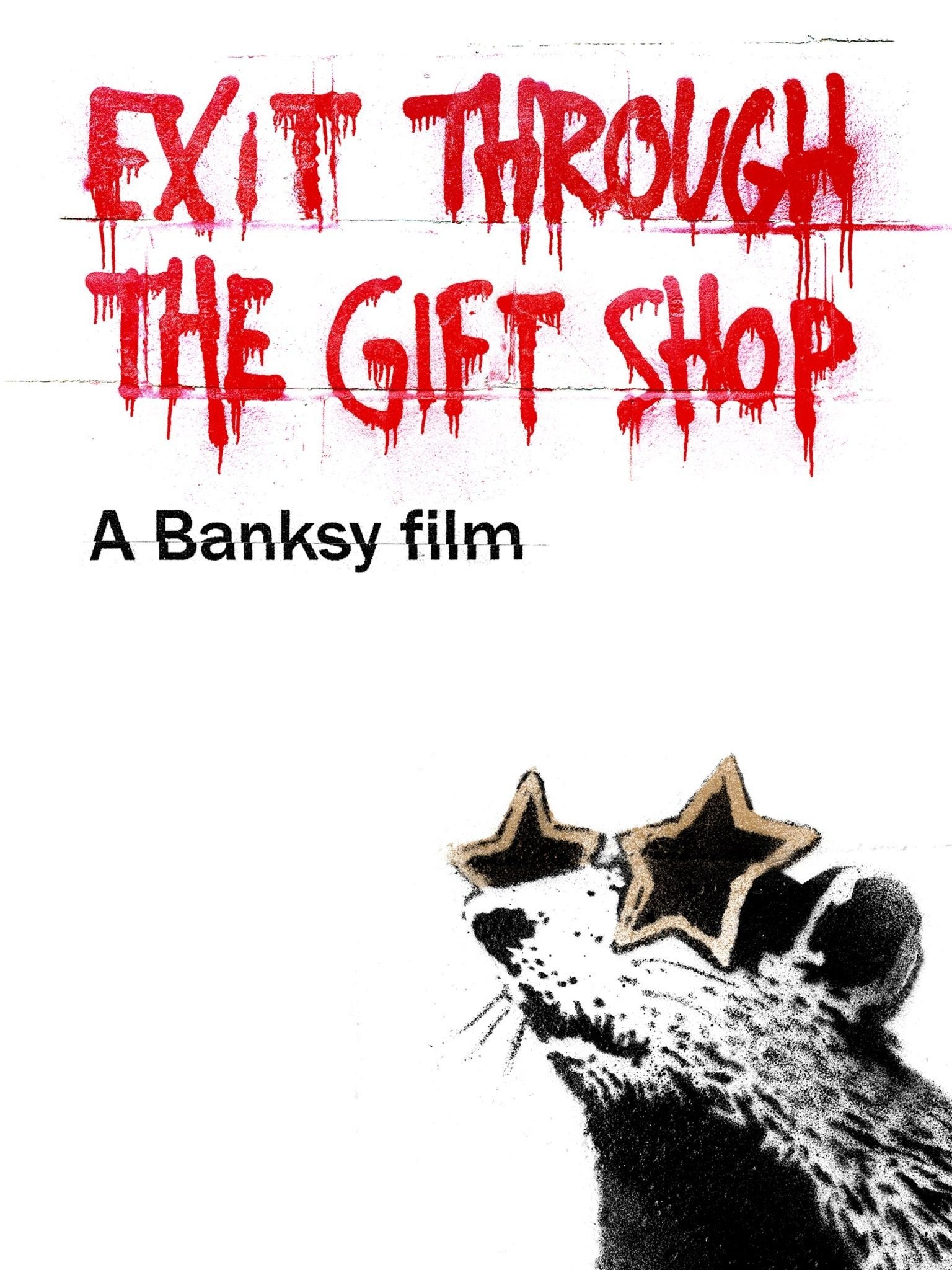
Banksy’s documentary, Exit Through the Gift Shop, is one of the most sophisticated upper-quadrant explorations of Quadrant C, demonstrating how marketing and propaganda work and the interplay between art and commercialism. While never telling you to believe anything, it matter-of-factly depicts the seemingly inevitable conveyor-belt ride of even the most transgressive art into commercial production lines once it enters the capitalist machine—as well as the inextricable relationship between art and branding, humanizing Thierry/Mr. Brainwash, the main character of the documentary, even as he comes to represent all that is wrong in the world.
You can for sure have messages in Quadrants A and B—art is a communication, it spreads ideas—but there’s a difference between transmitting an idea and imposing an ideology. The girlpower theme of Spy avoids slipping into eye-rolling, dogmatic feminism, and WALL-E manages to be environmentally conscious at heart without crossing into moralizing (although the obese evolution of humans was a bit too on the nose for my taste)—planting them in Quadrant B. Less artful examples that lean so heavily into didacticism, landing them in Quadrant D, include Pay It Forward and Crash. Such films are usually marked by earnestness and glowingly praised for having a good message. Many failed “prestige” films (and I mean aesthetic, not commercial, failures—like the aforementioned Spotlight) fall into this camp, as they seem driven by a desire to show their makers as good boys and girls who subscribe to the right ideology.
It’s not that imparting a message is inherently unaesthetic, but such didacticism usually goes hand in hand with artistic immaturity, bringing along with it juvenile reductiveness, intellectual handholding, and a lack of originality. The mechanics involved are in direct opposition to the workings of the river of aesthetics; instead of fishing things out of the mystical flowing waters of the collective unconscious and letting them flesh themselves out, one forces a narrative in the manner of a marketer making a commercial—or, here, a propagandist disseminating an ideology.
As certain ideologies—and the primacy of ideology above all else—become more in vogue, and the machinery of late capitalism and digital marketing makes it easier than ever to profit off the biases of the masses, we are seeing not just Quadrants C and D swelling with the would-be work of quadrant B, but we see the lines blurring between the bottom lower quadrants as well.
After the Matrix
After the matrix above, one descends into the lower rings of content like those of hell. One could probably make another matrix for this area, but who cares?
Closing
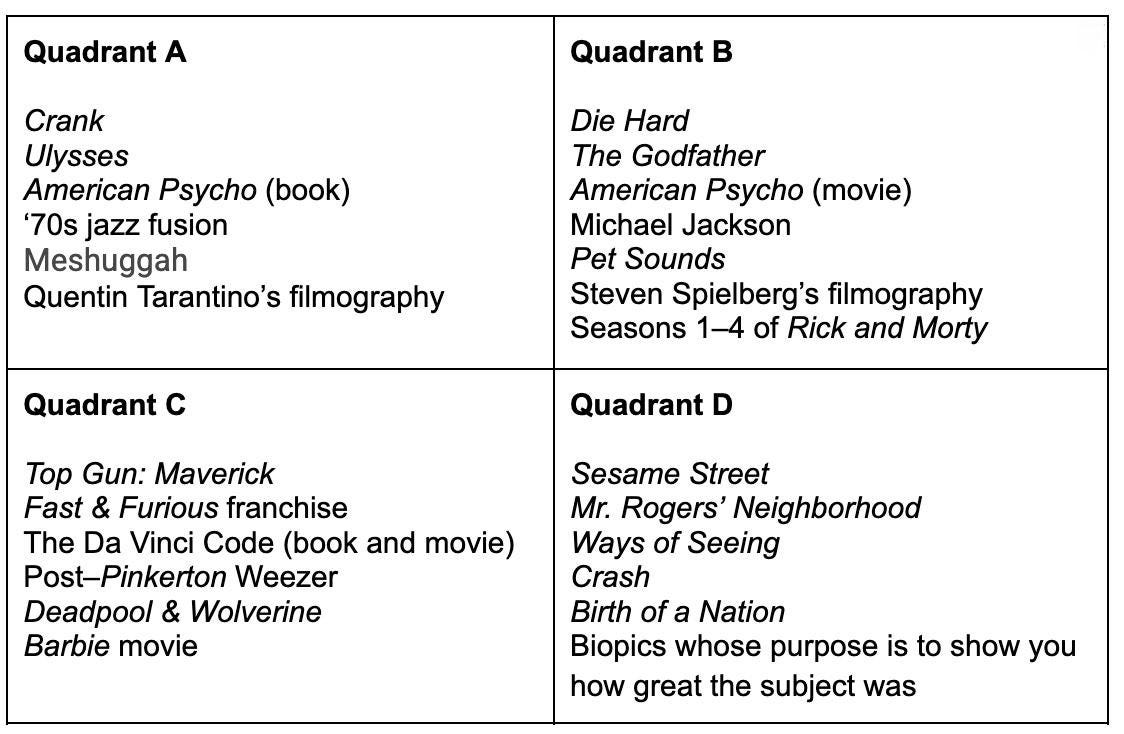
Here are some examples of works I would place in each quadrant. What would you add?
Like what you’ve read? Share it with your friends!
Want to help support my work?
XO,
Jesse
Not that there’s anything inherently wrong with content. I own a content marketing agency, so I’m not preaching against content itself. The problem becomes when people confuse content for art, and the arts and culture scene becomes overrun by slop and undiscerning masses.
My experience seeing Hateful Eight in the theater on my birthday is a testament to this: At the intermission, just as I was reveling in aesthetic ecstasies, feeling like the luckiest birthday girl in the world, an elderly woman seated next to us stage-whispered to her husband, “This is the worst movie I’ve ever seen in my life!”
High-brow journalism can also occupy this quadrant, as it operates in an aesthetic mode as narrative storytelling rather than exclusively as informational content. These stories belong to the same tradition as popular novels: ambitious but accessible works designed to draw readers in. Much of what passes for journalism today is engineered for engagement (including emotional manipulation and outrage bait), gaming the algorithm, and clandestine PR campaigns designed to influence public opinion, placing it, at best, in Quadrant D and most often beyond the purview of this essay, under the category of content marketing.
I have no desire to guilt-trip working artists in this quadrant with the wonderfully naive 90s anti-corporate ethos that was rampant in a time when artists could still afford to live cheaply in the major metropolises. It’s just much healthier for our culture to be able to call a spade a spade.
“‘Beverly Hills’ is arguably the most successful song ever released by Weezer, the song topped the Billboard Modern Rock Tracks chart for a week, spending months near the top of the Billboard Hot 100 (peaking at #10). As of January 2006, the digital single had been purchased over 962,000 times on iTunes, the song also did very well on other Billboard charts, such as Adult Top 40 (#8 peak), Hot Digital Songs (#1 peak) and Mainstream Rock Tracks (#26). Even with the success in sales, the song received mostly negative reviews from critics and fans. Many people consider ‘Beverly Hills’ to be one of the worst/most overrated songs by Weezer, because of its simple structure, the lyrics and the song’s lack of irony.” Source
Okay, I like this last one, as well as “The Greatest Man Who Ever Lived”—it’s not like they never wrote another upper-quadrant work ever again, but this became the exception and not the rule.
I suspect, and I’ll never really know for sure because all I ever see (or skip) is the finished product, but it’s likely that there’s a lot more television and movie “content” occupying a place in Quadrant B at first (before or during development) before they experience death by annotation. These stifling notes from execs may entail anything from neutering the piece for global audiences or making it “second screen” caliber (so unobtrusive and mind-numbing that it won’t compete with the audience’s primary device, their smartphone, to the point that they have to turn the television off, thus preserving engagement metrics) to any number of the idiotic notes driven by individual whim that only a corporate executive trained as a “creative,” and not an artist, can give a script.
“Orwellian” is a word that people like to throw around a lot these days. I think one of the most insidious, and ultimately destructive, examples of this kind of egregious linguistic inversion, for both individuals and the society at large, is the use of the word “identity” in place of “group.” This is driven in part by the digitization of human experience, where differentiation (the keynote of branding) has become imperative to selfhood, encouraging people to adopt signifiers that are easily recognizable within digital systems. More darkly, it’s also promoted by the economic interests of the various and often mysterious overlords of the internet age, including in large part advertisers, who stand to gain by having users “identify” themselves by group signifiers, as it makes it easier to market to them. The result is that, rather than describing who they are as individuals as an expression of their actual identity, people are now presenting what groups they belong to (race, gender, political affiliation, sexual orientation, etc.).
This was great, thanks.